1 Brigade strengthens civil-military ties, inter-agency collaboration to sustain gains against banditry in Zamfara
By Zagazola Makama
The Headquarters 1 Brigade, Nigerian Army, says it has continued to complement its ongoing kinetic operations against terrorists and bandits in Zamfara State with robust civil-military cooperation (CIMIC) initiatives and strengthened inter-agency collaboration, a strategy it says has improved public confidence, enhanced intelligence gathering and contributed significantly to security gains across its Area of Responsibility.
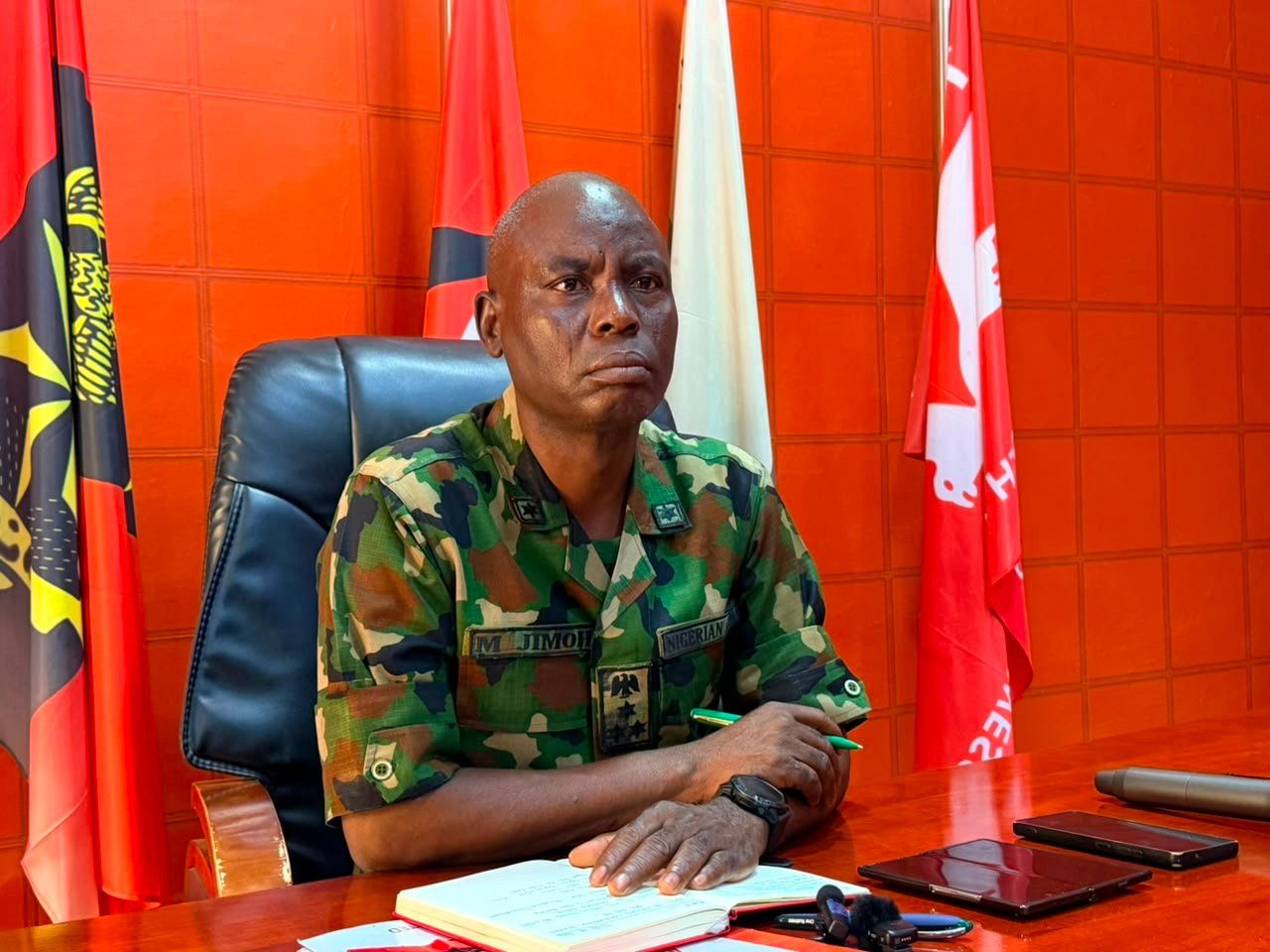
The Brigade Commander, Brig.-Gen. Mustapha Jimoh, said the Brigade had adopted a whole-of-society approach that combines military operations with humanitarian interventions and close partnerships with security agencies and local communities.
Jimoh, while presenting an operational brief on the activities of the Brigade, said military operations alone could not guarantee lasting peace without the active participation and trust of the civilian population.
According to him, the Brigade has continued to execute extensive Civil-Military Cooperation programmes designed to strengthen relations between troops and host communities while encouraging greater public participation in efforts to combat banditry and other security threats.
“The Brigade continued to execute robust civil-military cooperation activities aimed at enhancing public confidence, strengthening civil-military relations and fostering cordial relationships with host communities,” he said.
He explained that the programmes include free medical outreaches, humanitarian assistance, educational support initiatives, community engagement forums and sustained interactions with traditional rulers, religious leaders, youth and women groups, farmers and pastoralists.
Jimoh said these engagements have continued to build confidence between the military and local communities, resulting in improved intelligence flow and reduced support for criminal elements operating within the Brigade’s Area of Responsibility.
One of the Brigade’s major humanitarian interventions, according to the commander, was the distribution of shoes and school bags to vulnerable persons in selected Internally Displaced Persons (IDP) camps across Gusau, Tsafe, Maradun and Bukuyum Local Government Areas.
He said beneficiaries from the various local government areas were conveyed to Gusau by their respective local government authorities, where the items were formally presented as part of the Army’s humanitarian outreach.
The Brigade Commander also disclosed that troops distributed customised exercise books to thousands of pupils and students across several public educational institutions in Gusau as part of activities marking the 2026 Nigerian Army Day Celebration (NADCEL).
The beneficiary schools included Universal Basic Education Orphan and Primary School, Government Girls Arabic Secondary School, the School for Special Education, the School of Continuing Education, Tudun Wada Modern Primary School and Universal Basic Education Dangaladima Primary School, among others.
Jimoh noted that the educational support initiative was intended to encourage learning while reassuring parents and school authorities of the military’s commitment to creating a secure environment for education.
In the health sector, he said the Brigade organised a free medical outreach in Kauran Namoda, where residents received medical consultations and treatment as part of efforts to deepen the relationship between the Army and the civilian population.
The Brigade also carried out a school engagement programme at Government Girls Arabic Secondary School in Gusau during the Nigerian Army Day Celebration, providing students with opportunities to interact with military personnel and gain better understanding of the Army’s constitutional responsibilities.
According to Jimoh, the Brigade has equally facilitated the safe reopening of schools located within designated secure educational zones through sustained security operations and continuous engagement with relevant stakeholders.
He added that troops also executed several community development projects across the Brigade’s Area of Responsibility in line with the Chief of Army Staff’s directive on strengthening civil-military relations.
“The sustained Civil-Military Cooperation activities have deepened public trust and confidence in the Nigerian Army, improved intelligence flow and reduced support for criminal and hostile elements,” the Brigade Commander said.
Jimoh emphasised that intelligence supplied by local communities had continued to play a critical role in planning successful operations against terrorists and bandits across Zamfara State.
He said the Brigade therefore remained committed to expanding community engagement as a key component of its overall counter-banditry strategy.
On inter-agency collaboration, the Brigade Commander said Headquarters 1 Brigade has maintained strong operational synergy with sister services and other security agencies operating within Zamfara and Kebbi States.
He identified the Brigade’s principal partners as the 207 Quick Response Group of the Nigerian Air Force, the Nigeria Police Force, the Department of State Services (DSS), the Nigeria Security and Civil Defence Corps (NSCDC) and other relevant security organisations.
According to him, the collaboration is driven by coordinated operational planning, intelligence sharing and the conduct of joint security operations aimed at maximising available resources in addressing security challenges.
“The Brigade maintained excellent operational collaboration with the 207 Quick Response Group of the Nigerian Air Force, the Nigeria Police Force, the Department of State Services, the Nigeria Security and Civil Defence Corps and other security agencies operating within the theatre,” Jimoh said.
He further acknowledged the support of the Zamfara and Kebbi State governments, describing their contributions in logistics, intelligence, policy coordination and community engagement as vital to the Brigade’s operational successes.
The Brigade Commander said the partnership with state governments had strengthened institutional coordination and enhanced the effectiveness of ongoing military operations.
Jimoh also underscored the role of the media in supporting national security efforts, describing responsible journalism as an essential component of the country’s security architecture.
He said factual and timely reporting by credible defence correspondents helps to inform the public, strengthen confidence in security institutions, counter misinformation and deny criminal groups opportunities to manipulate public narratives.
“The Brigade remains committed to sustaining constructive engagement with responsible media practitioners while ensuring strict adherence to operational security considerations,” he said.
Despite the progress recorded, Jimoh acknowledged that the Brigade continues to contend with challenges, including vast operational terrain, expansive forest reserves, evolving criminal tactics, limited operational resources and trans-border criminal networks.
He said overcoming those challenges would require sustained cooperation among security agencies, improved intelligence gathering, stronger logistics support and greater participation by local communities.
Looking ahead, the Brigade Commander said Headquarters 1 Brigade would continue to intensify intelligence-driven operations while expanding civil-military cooperation programmes and strengthening partnerships with sister security agencies.
He said particular attention would remain on protecting educational institutions, farming communities and critical national infrastructure, facilitating the safe return of displaced persons and creating an environment conducive to socio-economic development across Zamfara and Kebbi States.
Jimoh reaffirmed the Brigade’s commitment to its constitutional responsibility of supporting civil authorities in maintaining internal security while working with communities and other stakeholders to achieve lasting peace in the North-West.