How Nigeria’s Defence Manufacturing Revolution Could Redefine Security in West Africa
By Zagazola Makama
For decades, Nigeria fought its wars with weapons built elsewhere. When insurgents struck in the North-East, when armed bandits overran villages in the North-West, or when pirates threatened commercial shipping in the Gulf of Guinea, the country’s response depended largely on decisions made in foreign capitals.
The Nigerian Armed Forces often found themselves waiting not only for equipment, but for export licences, diplomatic approvals and shifting geopolitical calculations that were beyond Abuja’s control.That dependency is now undergoing its most profound transformation since Nigeria established the Defence Industries Corporation of Nigeria (DICON) in 1964.
Inside expanding production lines in Kaduna, engineering workshops in Kakuri and research facilities connected to a new generation of defence innovators, the country is quietly attempting something unprecedented in its post-independence history: building a comprehensive military-industrial ecosystem capable of supplying much of its own defence requirements while positioning itself as a strategic security partner across West Africa.
The effort extends beyond manufacturing rifles or assembling military vehicles. It represents a broader national strategy to convert defence procurement into industrial development, technological innovation and strategic autonomy.
For much of its existence, DICON remained constrained by inadequate funding, obsolete production systems and limited technological capacity. Although it produced small arms ammunition and maintained some military equipment, Nigeria continued to import the overwhelming majority of sophisticated defence hardware. Counter-insurgency operations against Boko Haram and the Islamic State West Africa Province (ISWAP), campaigns against armed bandits across the North-West and sustained internal security deployments created enormous demand for ammunition, armoured platforms, communications equipment and maintenance capability. Yet procurement cycles were frequently delayed by bureaucratic procedures abroad, diplomatic disagreements and international restrictions. Successive governments recognised the vulnerability but struggled to overcome it.
The turning point came with the enactment of the DICON Act 2023, legislation that fundamentally restructured Nigeria’s defence manufacturing architecture. Rather than preserving DICON as a state-owned production corporation operating largely in isolation, the law reimagines it as the nucleus of an integrated defence industrial base involving government agencies, private manufacturers, universities, research institutions and international technology partners.
One of the legislation’s most consequential provisions encourages security agencies to procure locally manufactured defence equipment whenever domestic capability exists. Equally significant is its provision for private sector participation and joint ventures with foreign manufacturers willing to establish production inside Nigeria. The result is the gradual emergence of a genuine Nigerian military-industrial complex.
The implications extend well beyond economics.
It was increasingly argued that modern conflicts are won not merely through battlefield tactics but through the resilience of industrial supply chains. The war in Ukraine has demonstrated how ammunition production capacity can determine operational endurance. Similar lessons have emerged across conflicts in the Middle East and elsewhere, where nations possessing domestic manufacturing capabilities have enjoyed greater strategic flexibility than those dependent on external suppliers.
Nigeria’s experience has reinforced those lessons. During critical phases of its counter-insurgency campaign, delays in acquiring military hardware created operational constraints. Export controls, changing foreign policies and prolonged procurement timelines often complicated efforts to rapidly reinforce frontline formations. Domestic production seeks to eliminate those vulnerabilities.
Instead of waiting months for imported ammunition or replacement components, military logistics planners envision a system capable of producing supplies according to operational demand. Spare parts for armoured vehicles, tactical equipment, surveillance systems and increasingly sophisticated unmanned aerial platforms could eventually be sourced within Nigeria.
The transformation is not confined to factories.
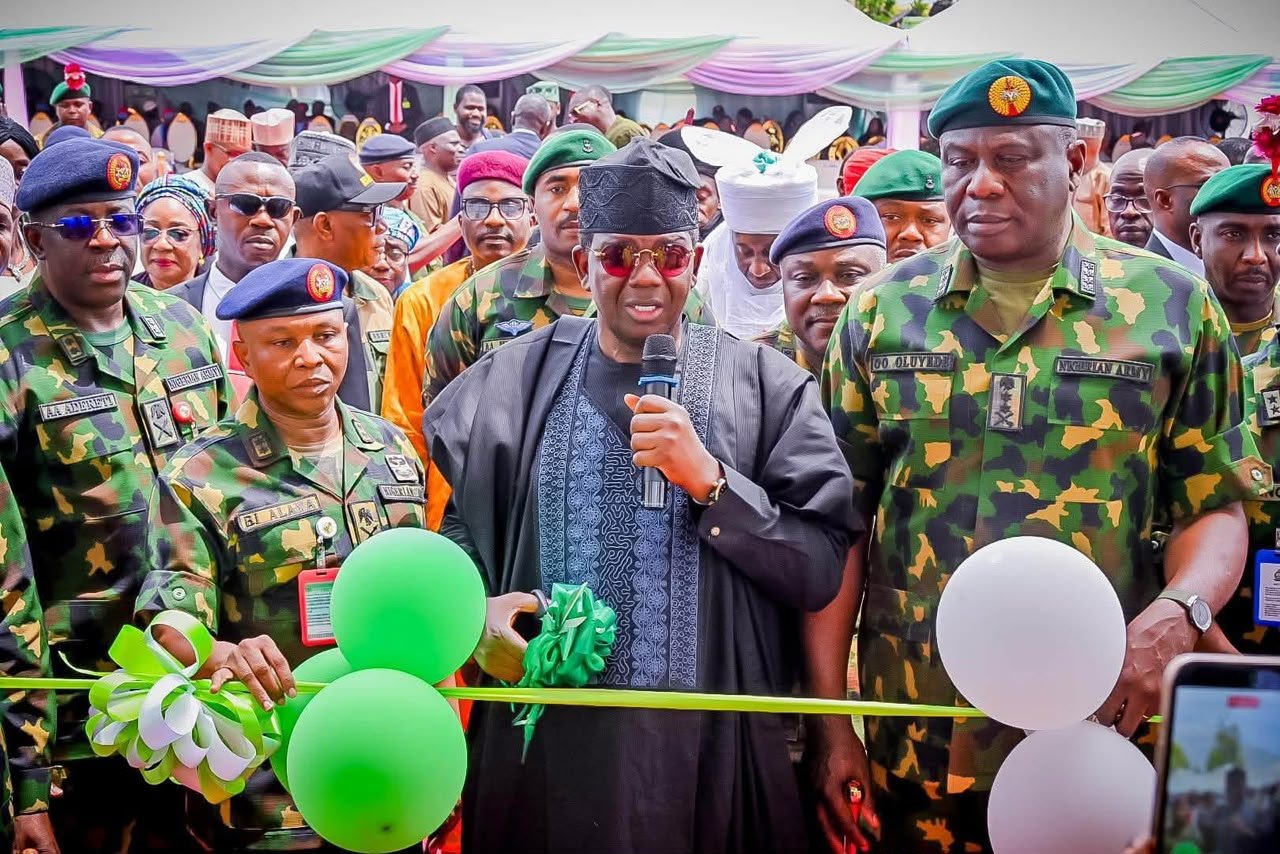
It increasingly depends upon classrooms, laboratories and research institutions capable of producing the engineers who will design the next generation of military technology. That objective gained institutional expression with the commissioning of the DICON Institute of Technology in Kaduna by the Minister of State for Defence, Dr. Bello Mohammed Matawalle.
Describing the institute as a milestone in Nigeria’s defence industrial journey, Matawalle said the country’s security future would depend as much on scientific expertise as on military hardware. “In today’s increasingly complex security environment,” he noted, “national defence depends not only on sophisticated equipment but also on the expertise, technical knowledge and innovative capacity of its workforce.” The institute represents the first statutory tertiary institution dedicated exclusively to developing skilled manpower for Nigeria’s defence manufacturing sector.
Its mission extends beyond conventional engineering education. Students are expected to specialise in defence-oriented technologies, advanced manufacturing systems, industrial design, electronics, materials science and innovation management disciplines considered essential for sustaining indigenous military production.
Alongside the institute’s inauguration, the minister also commissioned a new solar power system at DICON headquarters in Kakuri, symbolising a broader effort to modernise industrial infrastructure while improving production sustainability.
Major General Alaya, Director-General of DICON, said education represents the foundation upon which the entire defence industrial strategy rests.
He credits President Bola Ahmed Tinubu’s approval of the DICON Act as the legal catalyst that transformed long-standing aspirations into actionable policy.
According to Alaya, the institute has been designed to produce globally competitive engineers, technologists and innovators capable of supporting a modern defence industry while contributing to Nigeria’s broader industrial development.
Modern laboratories, specialised academic programmes and strategic partnerships with regulatory institutions such as the National Board for Technical Education are expected to ensure graduates possess internationally competitive technical competencies. The ambition reflects a shift in strategic thinking.
Rather than measuring defence capability solely through the acquisition of sophisticated weapon systems, policymakers increasingly regard indigenous technological capacity as a long-term national security asset.
The defence manufacturing initiative also carries significant economic implications. Nigeria spends substantial foreign exchange annually importing military equipment and associated spare parts. Domestic production could gradually reduce that outflow while stimulating local industries ranging from metallurgy and precision engineering to electronics, software development and advanced manufacturing. Every locally manufactured armoured vehicle or surveillance drone potentially supports Nigerian suppliers, creates skilled employment and strengthens industrial value chains that extend well beyond the defence sector. Technology developed for military purposes often finds civilian applications in telecommunications, robotics, artificial intelligence, aerospace engineering and manufacturing automation. Countries with mature defence industries including the United States, South Korea, Israel and Türkiye have repeatedly demonstrated how military research can accelerate wider technological development. Nigeria hopes to follow a similar trajectory, albeit on a different scale.
The consequences extend beyond Nigeria’s borders. West Africa is undergoing one of the most significant strategic realignments in its post-colonial history. Military governments across parts of the Sahel have reassessed longstanding security relationships with traditional Western partners. Counter-terrorism cooperation continues to evolve, while regional governments seek greater autonomy over defence procurement. Within that environment, Nigeria’s expanding industrial capability may alter regional security dynamics. As the largest military and economy within ECOWAS, Nigeria could eventually emerge as an alternative supplier of selected defence equipment for neighbouring countries. Such capacity would strengthen multinational operations around the Lake Chad Basin while reinforcing collective efforts against transnational terrorism, organised crime and maritime insecurity. It would also reduce dependence upon distant suppliers whose strategic priorities may differ from those of West African states.
Yet industrial ambition alone cannot guarantee success. Defence manufacturing requires rigorous regulation, financial discipline and transparent governance. Producing internationally competitive defence equipment requires sustained investment in research, testing, certification and workforce development. The industry must also remain commercially viable while maintaining strategic relevance.
Nigeria’s defence transformation remains incomplete. The country will continue relying on international partners for sophisticated fighter aircraft, advanced missile systems, strategic airlift capability and high-end radar technology for the foreseeable future. Yet the trajectory is unmistakable.
The question is no longer whether Nigeria should manufacture more of its own defence equipment. The question is how rapidly it can build an ecosystem capable of sustaining innovation, supporting military operations and strengthening regional security. For more than sixty years, DICON largely symbolised unrealised industrial potential.
Today, with legislative reform, institutional expansion and renewed political commitment converging, it is beginning to represent something more consequential: the possibility that Africa’s most populous nation may finally equip its armed forces with technology increasingly conceived, engineered and manufactured at home.
If that vision succeeds, Nigeria’s defence industry will become more than a supplier of military hardware. It will become a strategic instrument of national sovereignty, one capable of reshaping not only Nigeria’s security architecture but the future balance of power across West Africa.