Military operations restore peace in Benue Communities as over 1,000 IDPs return home – Commander
By: Zagazola Makama
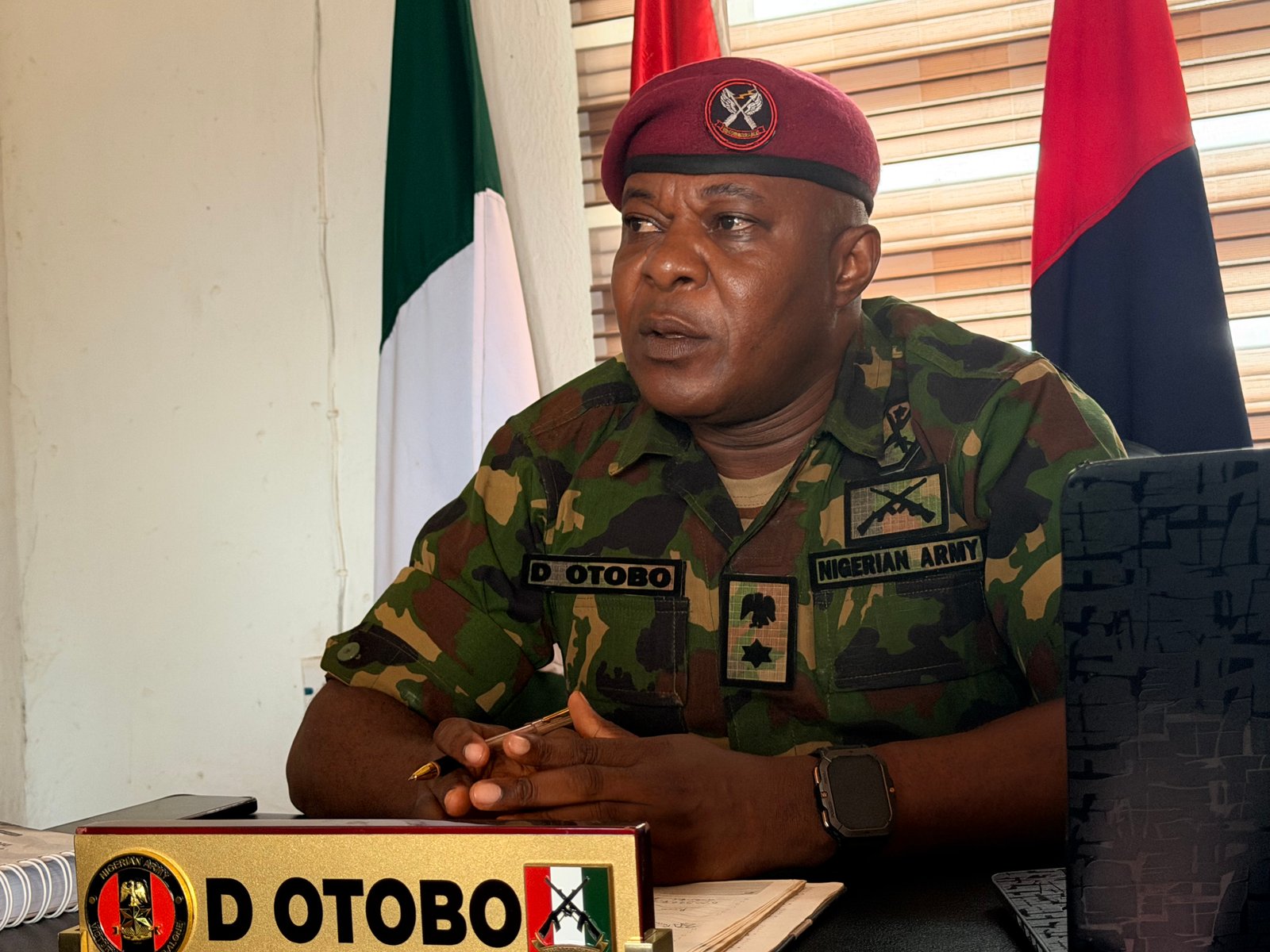
The Commanding Officer of Special Intervention Battalion 11, Lt.-Col. Donatus Otobo, says a combination of aggressive military operations and sustained peacebuilding initiatives has restored relative peace in Guma Local Government Area of Benue, leading to the return of more than 1,000 internally displaced persons (IDPs) to their ancestral communities.
Otobo disclosed this during an interaction with defence correspondents at the battalion’s operational base in Daudu, Guma Local Government Area.
He said the battalion was established specifically to tackle the persistent security challenges in Benue and underwent six months of intensive training at the Nigerian Army School of Infantry, Jaji, before its deployment on July 12, 2025.
The commander said that upon arrival in Benue, the battalion was assigned the task of securing a 30-kilometre stretch of road from the Nigerian Army School of Military Engineers (NASME) to Ude in Makurdi Local Government Area, an axis that had become notorious for banditry and violent attacks.
According to him, before the deployment of troops, civilians could hardly travel through the corridor without risking their lives.
“Before our deployment, no civilian could safely pass through this route. Anyone who attempted to do so risked being killed by bandits operating freely in the area.
“On July 13, 2025, we conducted our first reconnaissance mission and encountered bandits at about 10 different locations along the route.
“We engaged them and continued the mission. The following day, during a confirmatory reconnaissance, we had similar encounters and eventually identified this location as a suitable operational base from where we could project our forces and dominate the area,” he said.
Otobo said the battalion immediately launched aggressive clearance operations, advancing through forests and difficult terrain in search of criminal elements.
He explained that troops adopted a strategy of dismounting from vehicles and advancing on foot deep into the forests between the Makurdi-Lafia highway and adjoining communities, denying the criminals freedom of movement.
“Within two weeks of our deployment, we had completely flushed out the bandits from this area.
“We recovered two AK-47 rifles and neutralised three armed bandits during the operations.
“They attempted to resist and stop our advance, but they soon realised that we were determined and capable of sustaining pressure. That forced them to abandon the area,” he said.
The commander noted that the battalion’s early operational successes convinced military authorities to expand its area of responsibility to cover the entire Guma Local Government Area in addition to parts of Makurdi.
He described Guma as one of the most challenging operational environments in Benue because of its proximity to Nasarawa State.
According to him, armed groups frequently exploited the borders with Doma, Keana and Awe Local Government Areas of Nasarawa to launch attacks on communities in Benue before retreating across state lines.
“Before our intervention, Guma recorded an average of five to six attacks every week.
“Today, the situation has changed significantly. For the past six months, there has not been a single successful attack within Guma Local Government Area.
“This achievement is a result of aggressive patrols, area domination exercises, intelligence-driven operations and the continuous presence of troops across vulnerable communities,” he said.
Otobo said the improved security situation had transformed daily life for residents, particularly farmers who had previously abandoned their farmlands due to persistent attacks.
He explained that while troops initially escorted farmers and traders to ensure their safety, such measures had become less necessary because of the prevailing peace.
“What we do now is conduct regular farm patrols and dominate the environment.
“Farmers can now access their farmlands with confidence because of the security we have established.
“The need to escort traders and farmers has reduced significantly because people can now move around with less fear,” he said.
The commander also highlighted the battalion’s role in reversing the displacement crisis that had devastated communities across the area.
He said about 85 per cent of communities within the battalion’s area of responsibility had been deserted before the arrival of troops, with only two communities remaining inhabited due to the presence of military detachments.
“As we speak today, about 80 per cent of those displaced communities have returned to their ancestral homes.
“The few communities that have not fully returned are facing mainly economic challenges rather than security concerns.
“Many residents lost an entire farming season and are still trying to rebuild their livelihoods.
“At our last assessment, over 1,000 IDPs had left the camps and returned to their communities,” he said.
Beyond military operations, Otoogu said the battalion had deliberately adopted non-kinetic approaches to consolidate the gains recorded on the battlefield and prevent a resurgence of violence.
According to him, troops have facilitated several peace meetings involving farming communities, herders, traditional leaders and other stakeholders to address the root causes of recurring conflicts.
“What we are doing besides patrols is pursuing the non-kinetic approach.
“We have facilitated peace meetings between local communities and herders, and that has enhanced security in this area.
“People who previously could not sit together or even see eye-to-eye are now meeting on their own and resolving issues relating to encroachment on farmlands, grazing disputes and other community concerns.
“Our approach is to combine kinetic operations with dialogue and community engagement.
“When there is a threat, we respond aggressively. After that, we bring all parties together, engage stakeholders and encourage peaceful coexistence,” he said.
The commander said troops regularly interact with community leaders and residents to discourage reprisals and prevent actions capable of reigniting old tensions.
“We meet frequently with the communities and educate them on the roles they must play to sustain peace.
“We emphasise the need to avoid actions that could provoke fresh violence or trigger another cycle of reprisals, which had become common in this area before our deployment,” he said.
Otoogu attributed much of the battalion’s success to sustained support from the Chief of Army Staff (COAS), Lt.-Gen. Waidi Shaibu, Army Headquarters and the 401 Special Forces Brigade.
He said the Army Chief had maintained close oversight of the battalion’s operations and welfare since its deployment.
“The Chief of Army Staff considers this battalion a priority. Army Headquarters regularly checks on our welfare and operational requirements.
“He personally visited this location in March and directed immediate action on the challenges we presented.
“Within a week, the required support and equipment were provided.
“A few days ago, Army Headquarters also supported us in completing one of our structures that we require for operational purposes.
“We receive tremendous support from Army Headquarters and the 401 Special Forces Brigade, and that has contributed significantly to our success,” he said.
The commander further disclosed that the Army Chief had instituted a monitoring mechanism for all COAS Intervention Battalions across the country through designated desk officers who provide direct feedback on operational and welfare issues.
“The Chief of Army Staff has established a system where our challenges are reported every week.
“Any issue requiring immediate attention is addressed promptly. That has made a huge difference in our operational effectiveness,” he said.
Otobo said the welfare of troops had remained a top priority, noting that regular and timely payment of allowances had helped maintain high morale among personnel deployed in the area.
“The morale of my troops is very high because everything they need is provided.
“Their feeding arrangements are adequate, their allowances are paid ahead of time and we have not experienced delays in payments.
“When troops are properly motivated and supported, they remain focused on their mission and that is exactly what we are seeing here,” he said.
He reaffirmed the battalion’s commitment to sustaining the current peace, protecting lives and property and ensuring that displaced communities continue to rebuild their lives in a secure environment.
“We will continue to maintain pressure on criminal elements and sustain the gains we have achieved.
“Our objective is to ensure that the peace currently being enjoyed in Guma and parts of Makurdi becomes permanent and that residents can continue their normal lives without fear,” Otobo said.