Security Experts Unveil Policy Tools to Combat Ethnic Profiling, Call for Nationwide Adoption Ahead of 2027 Elections
Leading security and policy experts have called for urgent national and regional action to address the dangers of ethnic profiling and harmful stereotyping in security operations, following the conclusion of a landmark two-day conference in Nigeria’s capital.
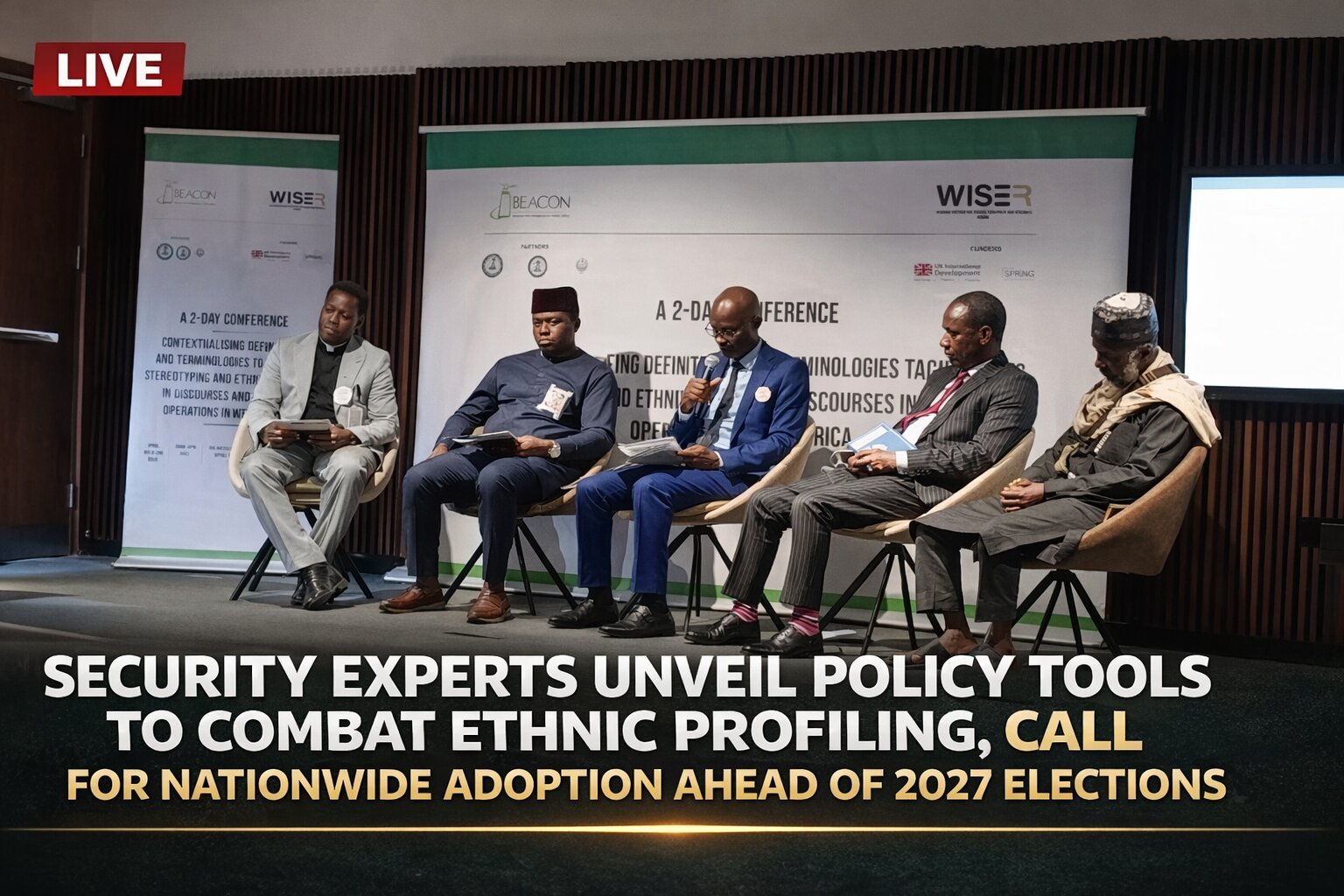
The high-level conference, convened by Beacon Security and Intelligence Limited in partnership with Whiteink Institute for Strategy Education and Research, was held from April 1 to 2 at the National Counter Terrorism Centre in Abuja. It brought together a broad coalition of stakeholders, including security agencies, government officials, civil society groups, media professionals, and members of the diplomatic community.
At the close of proceedings, the Founder and President of WISER, Saleh Bala, alongside the Managing Director of BSIL, Kabir Adamu, underscored the urgency of confronting narratives that fuel division and undermine effective security responses.
They warned that the misuse of language in both security discourse and public communication often reinforces dangerous stereotypes and weakens national cohesion.
“Flawed narratives and lazy categorisations frequently equate cultural identities with threats,” they said in a joint statement. “This initiative is aimed at correcting that trend by promoting accurate, responsible, and context-based communication.”
Deliberations at the conference, which spanned six intensive sessions, examined the root causes of identity-based violence, the legal and operational implications of terminology, and the media’s role in shaping public perceptions of conflict. Participants stressed that the classification and description of security threats can significantly influence trust, cooperation, and outcomes in conflict environments.
“The way we describe threats has real consequences. It can either promote understanding and trust or deepen division and suspicion,” the conveners noted.
A major outcome of the conference is the development of two key policy instruments: an Anti-Ethnic Stereotyping and Profiling Toolkit and a National Policy Brief. According to Dr. Adamu, the documents are designed to guide security agencies, policymakers, and the media in adopting non-stigmatising and operationally effective language.
The conference forms part of a broader peacebuilding initiative supported by the United Kingdom’s Foreign, Commonwealth and Development Office under its Strengthening Peacebuilding and Resilience in Nigeria (SPRING) programme. It also drew institutional backing from the Federal Ministry of Information and National Orientation and the Institute for Peace and Conflict Resolution.
Describing the engagement as a critical step toward a more inclusive security framework, Dr. Adamu emphasised that tackling harmful labelling is essential to building trust and fostering cooperation across communities.
In his remarks, Brig. Gen. Bala urged governments at all levels, regional organisations such as ECOWAS, civil society actors, and development partners to take ownership of the conference outcomes and ensure their implementation, particularly in the lead-up to the 2027 general elections.
“We must extend these recommendations beyond the federal level to subnational actors, where many of these tensions manifest,” he said.
He added that the finalised toolkit and policy brief would be submitted to relevant institutions as practical frameworks for improving security communication and strengthening national unity.
“Our goal is to ensure these are not just documents, but living frameworks that guide how we communicate, how we act, and how we build trust across communities,” Dr. Adamu concluded.
The conference attracted high-profile participation, including the National Coordinator of the NCTC, Maj. Gen. A.G. Laka; Minister of Information and National Orientation, Mohammed Idris; Minister of Women Affairs, Hajiya Iman Sulaiman-Ibrahim; Chief of Army Staff, Lt. Gen. Waidi Shaibu; and Chairman of the Senate Committee on National Security and Intelligence, Senator Yahaya Abdullahi, among others. Diplomatic representatives from Rwanda and Angola, as well as officials from the UK SPRING programme, were also in attendance.